
- New
BLOOMLED / INDOOR GROWING
Ref. FAC-CANFAN-200MM-900M3H

 Free delivery
Take advantage of free home delivery in France from 100 € of purchase
 Secure payment
Pay securely and pay by credit card in installments from €100 to €3,000
 Secure parcels
The boxes we ship are all of high quality
 Customer service
Contact us via chat, phone, email, Facebook, Instagram and TikTok
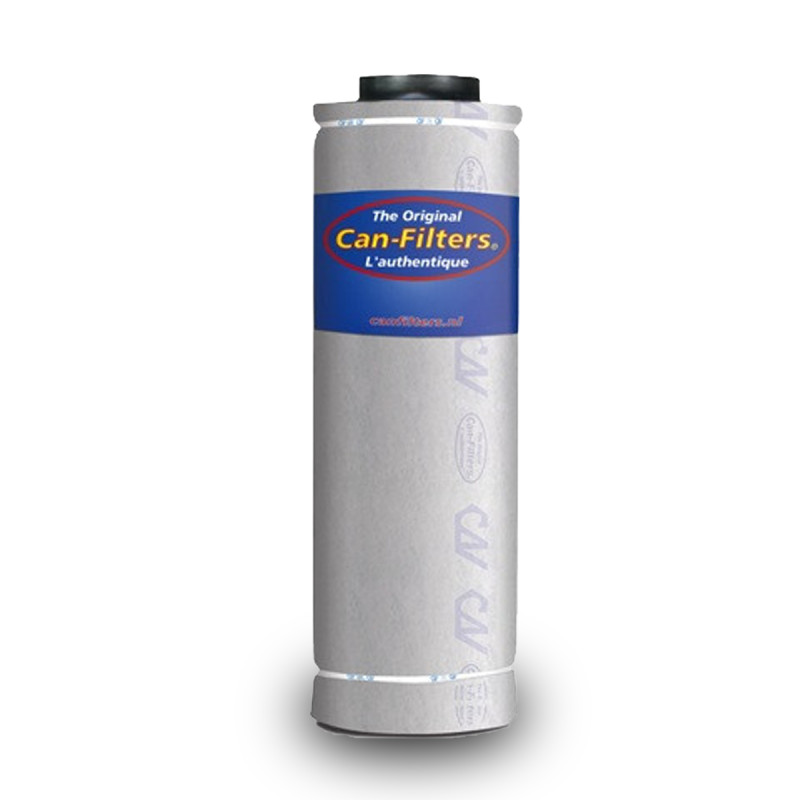
Complete odour neutralisation for your grow room — a CAN FILTER activated carbon filter in Ø200 mm, scrubbing up to 900 m³ of air every hour for large grow rooms and demanding multi-light setups.
Hand-picked and field-tested by BloomLED, the French indoor growing specialist with over 10 years of expertise: we only list kit we would run ourselves.
Ø200 mm · 900 m³/h · 65 mm carbon bed · 30-month lifespan
The CAN FILTER Ø200 mm carbon filter is the benchmark for growers who refuse to compromise on discretion. A 65 mm activated carbon bed holding 34.63 litres of media traps the volatile organic compounds responsible for odour before they ever leave your growing space. Built for 200 mm inline fans, it handles a peak airflow of 900 m³/h while keeping filtration efficiency at its best around 713 m³/h. This is equipment for serious installations: large grow rooms, multi-light spaces and drying areas.

Activated carbon works through sheer surface area. A single gram of activated media develops several hundred square metres of micro-porosity, and the odour molecules carried by the airflow bind to it through physical adsorption and never come back out. The thicker the bed and the longer the contact time, the higher the capture rate. At 65 mm, this CAN FILTER sits firmly in the premium bracket: where budget filters make do with 35 to 45 mm, it gives you a genuine safety margin, including late in flowering when the odour load peaks.
Choosing a Ø200 mm body is not a detail. An undersized filter becomes a bottleneck: the fan strains, static pressure climbs, real airflow collapses and noise rises. A 200 mm cross-section offers a far more generous passage than a 150 mm one, letting air move through the carbon bed without excessive turbulence. The result is lower pressure drop, a fan running inside its efficiency band, controlled power draw and a noise level that is genuinely liveable in a home.
To size your extraction properly, use one simple rule: the volume of your space should be exchanged roughly once per minute, then increased by 20 to 30 % to compensate for the resistance of the filter, ducting and bends. A 2.4 × 2.4 × 2 m room holds about 11.5 m³, which means close to 690 m³/h in theory and around 900 m³/h once losses are factored in. This filter is therefore sized to sit alongside a 200 mm fan on 4 to 6 m² of canopy, typically two to four high-power horticultural LED fixtures.
| Specification | Value |
|---|---|
| Brand | Can Fan (Can-Filters) |
| Reference | FAC-CANFAN-200MM-900M3H |
| Flange diameter | 200 mm |
| Maximum airflow | 900 m³/h |
| Recommended continuous airflow | 713 m³/h |
| Body length | 50 cm |
| Carbon bed thickness | 65 mm |
| Activated carbon volume | 34.63 litres |
| Estimated lifespan | 30 months |
| Compatibility | Ø200 mm inline fans |
| Mounting position | Vertical or horizontal |
| Retail price | €319.90 incl. VAT (€266.58 excl. VAT) |
Bed thickness directly determines how long air stays in contact with the carbon. At 65 mm, every odour molecule travels a path long enough to be adsorbed, even at sustained airflow. That is the difference between a filter that carries you through several cycles and one that fades before the first harvest.
Sized for 200 mm inline fans, this filter lets air through without generating excessive back pressure. Your fan stays inside its efficiency band, draws less power and fades into the background. You gain filtration performance and acoustic comfort at the same time.
Can-Filters specify a high micro-porosity density carbon matched to the terpene compounds plants release in flower. This is not generic industrial media: adsorption capacity stays stable over time and holds up under elevated humidity.
The filter installs standing or lying down, hung on straps or resting on a cradle. That flexibility simplifies your ducting layout and lets you shorten air paths, which in turn reduces overall pressure loss across the whole system.
In typical home use, with relative humidity held under 65 %, this filter covers several complete cycles with no meaningful drop in performance. The true cost per month of operation is far lower than cheap models that need replacing every year.
Our team has been growing, testing and sizing installations for over 10 years. We list the CAN FILTER Ø200 because it is one of the few filters whose stated performance matches what we measure in the field. Technical advice comes with it, before and after your purchase.
Installation calls for a few simple but decisive precautions. Always place the filter upstream of the fan, on the intake side: loaded air passes through the carbon first, then the impeller. Hang it high, in the warmest zone of the room, where odours naturally accumulate. Use suspension straps rated for its weight and seal the duct connection with a worm-drive clamp and, if needed, aluminium tape. A leaking joint means unfiltered air bypassing your entire system.
Maintenance comes down to one rule: never wash the carbon and never let it get wet. The fabric pre-filter wrapped around the body, on the other hand, should be hand-washed every two to three months and dried thoroughly before refitting. That single habit noticeably extends carbon life by stopping dust and particles from blinding the active surface. It is also worth flipping the filter at mid-life to even out wear across the bed.
Two mistakes come up again and again with newer growers. First, running the filter in blowing mode rather than on intake, which cuts its effectiveness sharply. Second, letting relative humidity sit above 70 % for long periods, which saturates the carbon with water and blocks the adsorption sites. A dehumidifier or tighter irrigation management fixes the problem and will save you a whole filter over time.
A 200 mm inline fan delivering between 700 and 1000 m³/h is the ideal match. Below 700 m³/h you are not using the filter's potential; above 1000 m³/h the contact time with the carbon becomes too short and odour control drops off. A variable-speed model, or one driven by a fan controller, lets you fine-tune airflow to each stage of the grow.
Yes. Performance is immediate and at its maximum from the moment you switch it on, with no break-in or activation step required. We simply recommend running the extraction for a few minutes before opening your grow space, so the room is already under negative pressure and no odour escapes through the door.
Estimated service life is 30 months under normal conditions, roughly four to six complete grow cycles. That figure depends heavily on three factors: average relative humidity, daily extraction runtime and the odour load of the varieties you grow. In a dry, well-managed environment, many users comfortably exceed the estimate.
Absolutely. The CAN FILTER Ø200 accepts vertical and horizontal mounting with no performance penalty. The only constraint is mechanical: make sure the support spreads the weight properly and that the duct connection is not under tension. Horizontal mounting on a cradle is often the best option in rooms with low ceilings.
The first signal is your nose: if odours start breaking through while your extraction is correctly sized and the joints are sealed, the carbon is reaching saturation. A second clue is a filter noticeably heavier than when new, a sign it has taken on a lot of moisture. If in doubt, the BloomLED team can help you diagnose your setup.
65 mm of activated carbon and 34.63 litres of media: the CAN FILTER Ø200 mm plays in the professional league, with a performance margin that keeps you completely discreet even at peak flowering.
Data sheet
6 other products in the same category:
BloomLED / Culture indoor
Supply in progress
BloomLED / Culture indoor
In stock - Express shipping available
BloomLED / Culture indoor
In stock - Express shipping available
BloomLED / Culture indoor
Supply in progress
BloomLED / Culture indoor
Supply in progress
BloomLED / Culture indoor
Last items in stock
Complete odour neutralisation for your grow room — a CAN FILTER activated carbon filter in Ø200 mm, scrubbing up to 900 m³ of air every hour for large grow rooms and demanding multi-light setups.
Hand-picked and field-tested by BloomLED, the French indoor growing specialist with over 10 years of expertise: we only list kit we would run ourselves.
Ø200 mm · 900 m³/h · 65 mm carbon bed · 30-month lifespan