
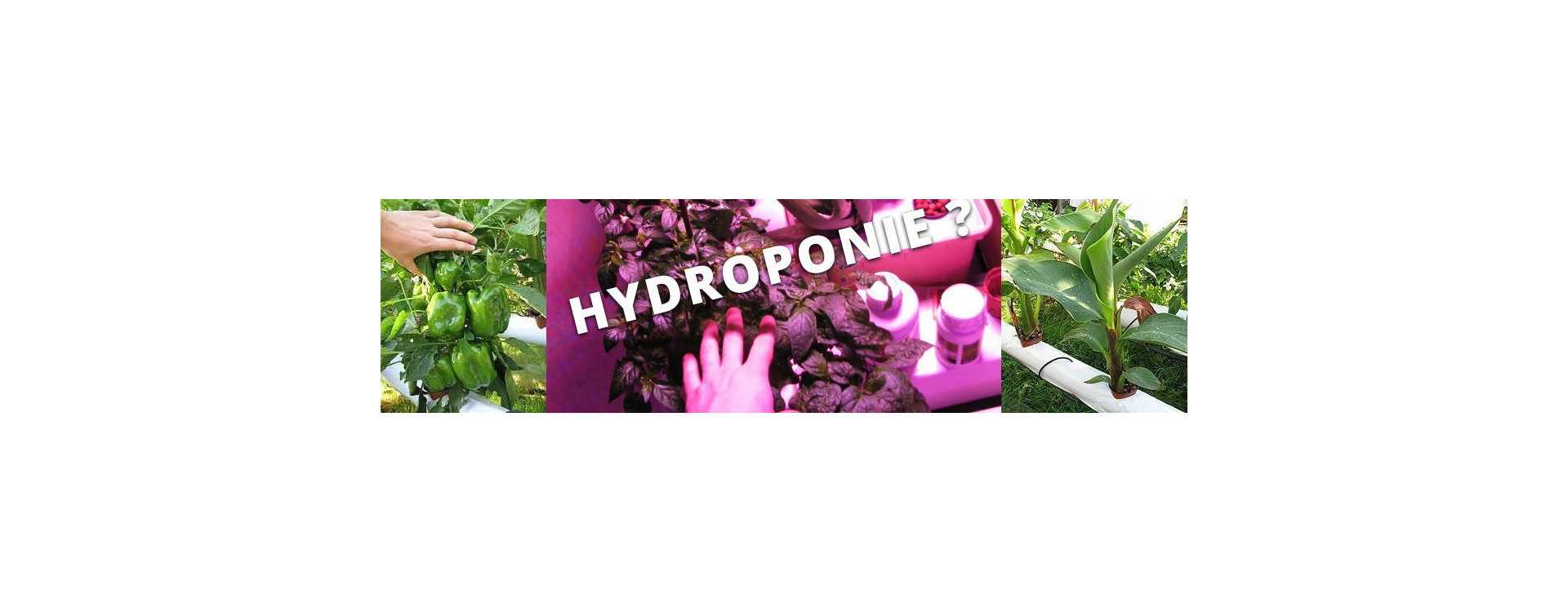
What is hydroponia ?
You may have noticed, but we have included soilless or “hydroponic” growing systems in our catalog.
This is not without reason. I started growing indoors in 2006 and from my second cultivation I wanted to do without potting soil. Indeed, hydroponics is a technique for growing plants without soil. The basic principle of a hydroponic system is to use a tank filled with water and fertilizer , in order to bring these to the feet of the plants which are in a substrate such as clay balls.
There are different cultivation techniques without soil. Drip, aeroponics, NFT, wick etc….
In my case, I started with a drip growing system. I had stacked two large bins. The upper part was filled with clay balls and the lower tray served as a reservoir to contain water and fertilizers. A pump was placed in the water to cause the nutrient solution to rise directly to the feet of the plants and then fall back into the lower tank.
Growing in hydroponics is not harder than growing in soil. In my opinion it's even simpler and more automated. I once went on vacation with a crop on the way without losing a single plant. It's like having automatic watering.
In a culture without soil, you will have to control and adjust if necessary, the acidity of the water and the fertilizer rate . The first is therefore the pH and the following is the EC for electro conductivity. As for the pH, it's very simple, you place an electronic or drop tester (like for aquariums) and you adjust with a “pH Down” or “pH plus” type liquid. For my cultures I tried to stay around 6.0 pH and it went very well . If you go too high or too low, your plants will suffer damage.
I also talked about EC, and it's even simpler than pH! You calculate your EC, which therefore corresponds to the rate of fertilizer in the water. You will have understood, if it is too low, you add fertilizer, if it is too high, you add water. It's that simple. These are the only two parameters that you will have to manage for growing hydroponically.
We have added aeroponic growing systems to our catalog. So, I talked to you about drip culture, and the first systems we are releasing are aeroponics?! Let me explain why. In 2008, on forums etc… (I don't know yet if this is the case today) but aeroponics was what the unicycle is to the bicycle. The same function but with more difficulty.
If you see this today, I stand behind your next aeroponic crop. It's a simple system to set up, you'll never hear about buffering. I'll let you discover a video that I published to show how to stamp clay balls. I think this video speaks for itself. You don't want to do that!
Aeroponics will therefore be your best solution. So no clay balls, no rock wool, no coconut fiber etc… Your plants will grow in a total vacuum. These are sprinklers like you see for watering corn crops but the size of a thumb. You will also be able to see your roots directly to be able to monitor the health of your plants.
This is why we selected aeroponic systems. You receive, you fill your tank and off you go.
On the other hand, if there is a big flaw in aeroponic cultivation, I have to be honest. Throughout your cultivation, you should NEVER, I said NEVER, leave your system without a pump running for several hours. With a substrate you have a wider margin for error. But hey, if you take care of your plants like a good father, there will never be this problem.
Here is a short video of the Aeroponics / NFT system that I designed when I was 18 years old.
Get started! You can grow whatever you want hydroponically, I even managed to grow a canna flower plant and a banana tree.
Our team and I remain at your disposal!
If you have grown hydroponically with a BloomLED LED horticultural lamp, send us a little photo ;-)
Joseph - BloomLED Director and indoor grower since 2006
Related posts
 Zoom on the SpectraMODULE X135 LED horticultural lamp
Discovery of future SpectraWILD LED horticultural lighting
Moving plants from the growth to flowering phase in indoor cultivation
How to grow seeds indoors under LED horticultural lamps
A new method of fixing for SpectraLINE LED horticultural systems
Zoom on the SpectraMODULE X135 LED horticultural lamp
Discovery of future SpectraWILD LED horticultural lighting
Moving plants from the growth to flowering phase in indoor cultivation
How to grow seeds indoors under LED horticultural lamps
A new method of fixing for SpectraLINE LED horticultural systems